As a Debtor, What Basic Protections Do You Have Under Different Legal Systems?

June 12, 2026|⏱️~10 minutes
By Marcus Holt
Every legal system faces a difficult question: when someone can't pay their debts, how far should the law go to protect them?
Most public discussion focuses on the moral duty to "pay what you owe." But modern laws already include many protections designed for debtors. These protections are not about encouraging people to default. They are based on economic reasoning.
Evidence suggests that giving "honest but unfortunate" debtors a fresh start helps reduce long-term social welfare costs, keeps people in the workforce, and may even encourage reasonable risk-taking in business.
Below, we look at four jurisdictions: the United States, the European Union, the United Kingdom, and China. We will examine what protections debtors actually have, why these rules were designed the way they were, and what their limits might be.
1. The United States: The "Automatic Stay" as a Fresh Start
In the U.S., the most powerful legal tool for debtors is the automatic stay under Section 362 of the Bankruptcy Code.
Once a debtor files for bankruptcy, the stay takes effect immediately – no court approval needed. All collection calls, lawsuits, wage garnishments, and foreclosure proceedings must stop right away.
In practice, the stay gives debtors a breathing window. For Chapter 7 (liquidation), that window is usually 4 to 6 months. For Chapter 13 (reorganization), it lasts the entire 3-to-5-year repayment plan. Creditors can ask the court to lift the stay, but they bear the burden of proof. They must show "irreparable harm" to their interests.
Recent trends
Industry data shows that consumer bankruptcy filings in the U.S. have increased. According to Epiq AACER (January 2026), total consumer bankruptcy filings in 2025 reached 533,949 – about 12% higher than the 478,752 filings in 2024. In December 2025 alone, consumer filings hit 43,387, a 21% increase from December 2024.
As economic pressures rise – higher interest rates, expiring pandemic support, and growing household debt – the automatic stay plays a larger role as a safety valve. But it is still unclear whether this upward trend will continue or if it mainly reflects temporary financial stress.
Protection against abusive collection
The Fair Debt Collection Practices Act (FDCPA) adds another layer of protection. It bans debt collectors from using harassing, deceptive, or unfair practices.
Data from early 2026 shows an increase in FDCPA-related federal lawsuits. In March 2026, there were 413 such cases – a 17.3% increase from February (source: ACA International via WebRecon, May 2026). The Consumer Financial Protection Bureau (CFPB) has also stepped up enforcement, with several collection firms facing fines and corrective actions.
However, some academic analysis suggests that certain court rulings could weaken the CFPB's enforcement power. Debtors may need to rely more on state court individual lawsuits to protect their rights in the future (Northwestern University School of Law, March 2026).
Overall assessment
The U.S. model emphasizes "after-the-fact" relief – a clear legal exit for people already in deep trouble. Its strength is strong protection and relatively clear filing rules. The downside: bankruptcy has a severe impact on credit scores, and legal fees plus court costs can still be a barrier for the poorest debtors.

2. European Union: A "Prevention First" Approach
Unlike the U.S., the EU has recently focused more on preventing over-indebtedness before a loan is even made.
On November 20, 2026, the EU's new Consumer Credit Directive 2 (CCD2) takes effect across all 27 member states, replacing the 2008 directive (source: EU Directive 2023/2225). The new rules bring several important changes:
Broader scope. Small loans (under €200), "buy now, pay later" services, and interest-free loans are now covered. Any BNPL provider operating in the EU must assess the consumer's ability to repay, just like a bank.
Mandatory creditworthiness assessment. Lenders must assess creditworthiness from a "consumer protection" perspective. If the assessment shows a high risk of over-indebtedness, the lender must refuse the loan – even if the consumer actively applies for it (source: PayTechLaw, May 2026). This turns "responsible lending" from a voluntary industry practice into a legal duty.
Human review right. If the credit assessment uses automated processing (e.g., an AI scoring model), consumers have the right to request human intervention and review. In an age where algorithms decide who gets credit, this clause is designed to preserve procedural fairness.
CCD2 is a "full harmonization" directive. Member states cannot add extra requirements above or below the uniform standard. This creates a single minimum level of protection across the entire EU market (source: Taylor Wessing, June 2025). Germany's implementing law is expected to take effect on the same date – November 20, 2026 – and will extend rules against tied selling from real estate loans to all consumer loans (source: same).
Philosophy and open questions
The EU approach is a kind of "soft paternalism." It assumes that consumers may not accurately judge their own debt capacity, so the law forces lenders to act as gatekeepers. A potential downside is that people with weaker credit histories or unstable incomes may find it harder to get any credit at all.
Since CCD2 only took effect at the end of 2026, its actual impact – including whether it reduces credit access for marginal groups – will need several more years of study.
3. United Kingdom: The More Modest "Breathing Space" Scheme
The UK launched its Debt Respite Scheme (Breathing Space) in 2021. It is a temporary protection that does not require entering bankruptcy.
Eligible individuals receive a 60-day legal protection period. During this time, most interest and penalties are frozen, and creditors cannot take enforcement action. For people receiving mental health crisis treatment, the period can be extended to the end of treatment plus 30 days (source: Insolvency Service UK).
What the data shows
In February 2026, England and Wales recorded 5,102 Breathing Spaces. On an annualized basis, roughly one in every 550 adults entered the scheme over the past year (source: Insolvency Service, March 2026). However, this number was 35% lower than February 2025. The official explanation is that a major debt advice organization changed its eligibility criteria – not that demand fell.
Citizens Advice reported that in 2025, it helped over 400,000 people with debt problems – about 45% more than in 2021. The average debt per person was roughly £9,000, also 36% higher than in 2021 (source: Citizens Advice, January 2026).
These figures suggest that debt problems have become more severe among ordinary people, while awareness and use of the Breathing Space scheme have grown significantly over the past several years.
Important limits
Breathing Space is not a magic shield. The UK Supreme Court ruled in 2025 that the principal amount of secured debt is not protected – only interest and fees are covered (source: UK Supreme Court, 2025). In other words, Breathing Space can temporarily stop mortgage interest from accruing, but it cannot prevent the lender from eventually repossessing the home.
In its five-year evaluation report, Citizens Advice also admitted that the 60-day period is often not long enough for people with complex debts, negative cash flow, or health problems (source: Citizens Advice, January 2026).
Comparing with the U.S.
Compared to the U.S. automatic stay, the UK's Breathing Space is a "light-touch" tool. It does not require bankruptcy, and it has a smaller impact on credit records. But the protection it offers is also weaker – it works best for short-term liquidity crises rather than deep insolvency.
4. China: A Limited Pilot of Personal Bankruptcy
For a long time, China had no personal bankruptcy system at all. That changed in 2021 with the first local regulation: the Shenzhen Special Economic Zone Personal Bankruptcy Ordinance.
According to data from the Supreme People's Court's 2026 work report, as of March 2026, Shenzhen courts had accepted 810 personal bankruptcy cases, resolved about 251 million yuan (approx. US$35 million) in debt, and helped more than 600 families escape debt burdens. The Shenzhen Bankruptcy Affairs Administration provided pre-application counseling to over 6,700 people, handled 803 cases, and ultimately helped 308 debtors achieve debt relief (source: Shenzhen Bankruptcy Affairs Administration five-year reform report, 2026).
In November 2025, the first-ever personal bankruptcy liquidation case in China completed its four-year "discharge supervision period." The remaining undischarged debt was legally wiped out. This marked the first full cycle of China's personal bankruptcy experiment (source: Supreme People's Court 2026 work report).
Xiamen also launched its own local personal bankruptcy protection ordinance in November 2025, and within four months it had accepted 11 cases (source: Supreme People's Court 2026 work report; Fujian Legal Daily, March 2026).
The core standard of the Shenzhen model is "honest but unfortunate." Statistics show that over 80% of applicants had stable jobs, and more than half had monthly incomes between 5,000 and 15,000 yuan. They are not professional fraudsters trying to escape debt. They are ordinary people who ran into trouble due to business failure, illness, or spending imbalances.
A realistic caveat
China's personal bankruptcy system is still a limited local pilot. There is no national framework yet. Compared to the enormous scale of personal debt in China – hundreds of millions of credit card users and consumer credit customers – 810 accepted cases is statistically very small. Some observers believe these pilots are more about sending a policy signal and testing legislation than providing widespread relief. A revised Enterprise Bankruptcy Law has included personal bankruptcy provisions for review, but when (and if) it will be enacted nationwide, and how well it will work in practice, remain highly uncertain.

5. Comparing the Four Models
Putting these four jurisdictions side by side reveals four different protection philosophies:
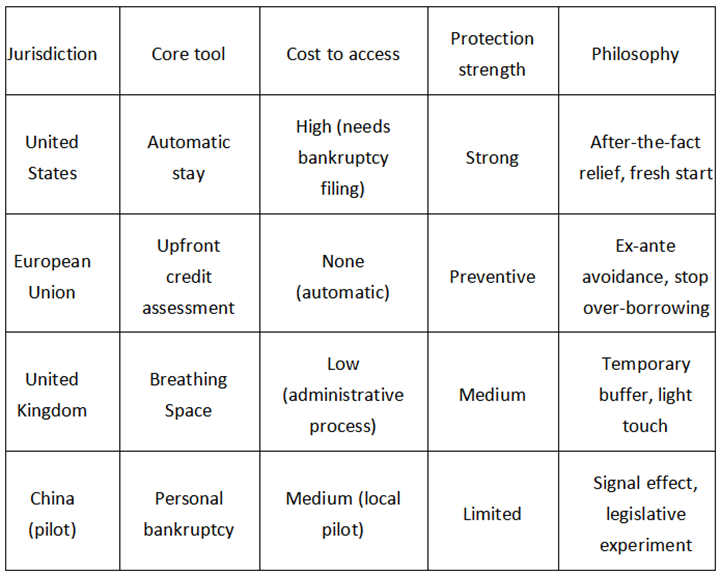
No single model is "best" for every economy. The U.S. approach works better in a credit-rich society that is relatively tolerant of individual failure. The EU approach fits a more risk-averse environment with strong consumer protection traditions. The UK's Breathing Space is a compromise, particularly suited for people hit by short-term shocks like job loss or illness. China's pilot, while still small in scale, represents a significant shift for a legal system that long denied the very possibility of personal bankruptcy – and that shift itself is important.
It is also worth noting that the real-world effectiveness of these laws depends heavily on local judicial capacity, the strength of credit reporting systems, and legal culture. A well-designed law will not help much if courts lack resources or enforcement is weak.
6. Conclusion: What Debtor Protection Is – and What It Is Not
One common misunderstanding needs clearing up: debtor protection does not mean letting people walk away from debts they could pay. In almost all legal frameworks, deliberate evasion, hiding assets, and fraudulent transfers are still severely punished. Debtor protections are aimed at people who cannot pay for reasons beyond their control – illness, job loss, economic downturn, or business failure that was not reckless.
From a macroeconomic perspective, a society with reasonable debtor protection channels may be more resilient than one that pursues "tough on debt" policies at all costs. The reason is simple: if the cost of failure is too high, rational people will avoid any risky activity. And excessive risk aversion ultimately suppresses innovation, entrepreneurship, and workforce mobility.
For the average reader, the practical value of understanding these protections is knowing what legal options exist – for yourself or someone you know – when financial trouble hits. Rules vary greatly across countries, and they keep changing. The EU's CCD2, for example, only took full effect at the end of 2026; it will be several years before we can assess its long-term impact.
If you are facing a real debt problem, the safest step is always to consult a local legal professional.
Disclaimer:
The information in this article is a general introduction to legal protections in different countries. It is not legal advice. Laws and regulations change over time and vary by jurisdiction. For advice on a specific debt situation, please consult a qualified lawyer.
About the Author
Marcus Holt has long been concerned with the protection of financial consumers' rights and interests as well as issues related to cross-border fraud. His research and writings cover digital fraud, personal data security, and the trend of global financial regulation convergence. He has participated in several international consumer protection research projects and maintains close collaboration with regulatory agencies and cybersecurity experts. He is committed to converting complex fraud techniques and regulatory policies into clear and practical public knowledge, helping readers protect themselves in the increasingly digital financial environment.
References
[1] Citizens Advice. More room to breathe: Building on five years of Breathing Space (Jan 2026)
[2] Epiq AACER. Consumer bankruptcy filings 2025 annual report (Jan 2026)
[3] EU Directive 2023/2225. Consumer Credit Directive 2 (CCD2)
[4] Fair Debt Collection Practices Act, 15 U.S.C. § 1692 et seq.
[5] Insolvency Service (UK). Individual insolvencies, February 2026 (Mar 2026)
[6] Northwestern University School of Law. The Dual Retrenchment Trend in FDCPA Enforcement (Mar 2026)
[7] Shenzhen Bankruptcy Affairs Administration. Five-Year Reform Results Report (June 2026)
[8] Supreme People's Court of China. 2026 Work Report (Mar 2026)
[9] Taylor Wessing. New Consumer Credit Directive: Comprehensive Changes for E-Commerce, BNPL, AI, and Data Protection (June 2025)
[10] U.S. Bankruptcy Code, 11 U.S.C. §§ 101-1532
[11] World Bank. Principles for Effective Insolvency and Creditor/Debtor Regimes (Mar 2026)
RELATED GUIDES
Why Haircuts Keep Getting More Expensive in Developed Countries: The Economic Logic of Non-Tradable Services
Over the past two decades, the cost of a haircut in developed countries has consistently outpaced overall inflation. I
Is Your Voice Safe as a Password?Evaluating Voice Recognition in Remote Banking
In recent years, more and more banks have started using voice recognition to verify customers' identities over the phone and in mobile apps.
As a Debtor, What Basic Protections Do You Have Under Different Legal Systems?
Every legal system faces a difficult question: when someone can't pay their debts, how far should the law go to protect them?
Trust Inflation: How to Spot AI-Forged Government Documents
Trust is an economic infrastructure. It lowers transaction costs. It lets strangers exchange value, sign contracts, and follow authority.