
What does it signify if the US FedNow and India's UPI eventually collaborate?
June 8 ,2026|⏱️~9 minutes
By Nicholas Brennan
As of today, FedNow and UPI are not directly connected. Their cooperation is still in the stages of rule adjustments, technical talks, and early pilots.
But that doesn't mean this topic isn't worth following. In April 2026, the Federal Reserve issued a significant rule change proposal. If approved, it would remove a key regulatory barrier for FedNow participants to use intermediary banks for cross border payments. Some analysts have called it "the most strategic policy move" for FedNow since its launch in 2023.
So, if they eventually connect, what would it mean?
1. Two payment systems at very different scales
To understand the potential impact, you first need to see where each system stands today. The gap is not about technical maturity, but about stage of development and transaction volume.
Facts about UPI
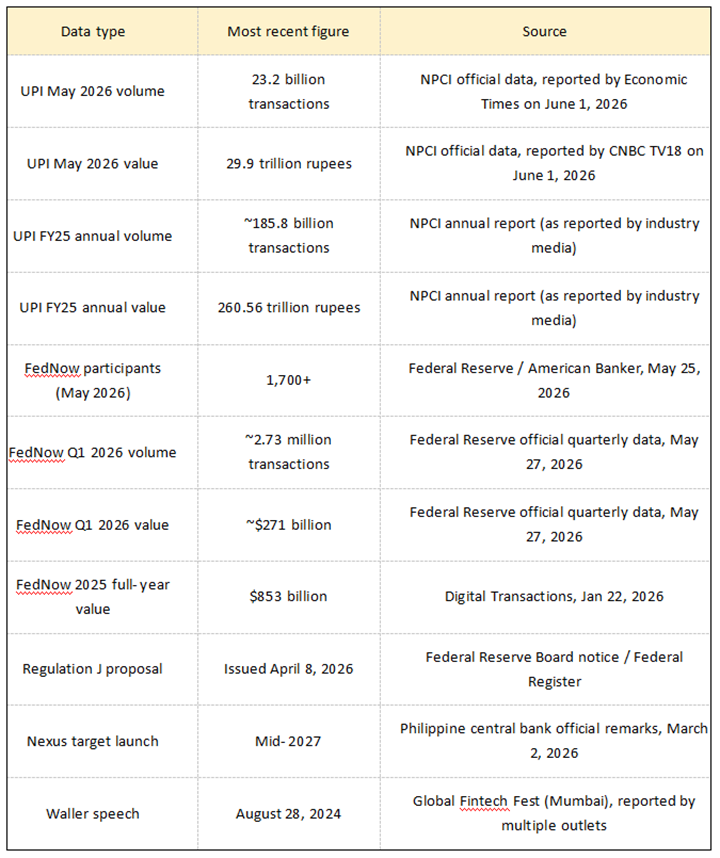
UPI, operated by the National Payments Corporation of India (NPCI), launched in April 2016. It is the backbone of India's digital payments. According to NPCI data released on June 1, 2026, UPI processed 23.2 billion transactions in May 2026, with a total value of 29.9 trillion rupees (about $358 billion). That means in a single month, UPI handled roughly 27 times the total transaction value FedNow processed for the entire year of 2025.
For the full fiscal year 2025 (ended March 2025), UPI handled about 185.8 billion transactions, worth 260.56 trillion rupees (about $3.04 trillion), up 42% and 30% year over year, respectively. Ritesh Shukla, CEO of NPCI International, recently said that UPI currently handles about 40% of the world's real time payment transactions.
Facts about FedNow
FedNow, operated by the U.S. Federal Reserve, launched in July 2023. According to Fed data, as of May 2026, more than 1,700 institutions had joined FedNow, with assets ranging from under $500 million to over $3 trillion.
In terms of transaction volume, FedNow processed 8.41 million transactions in 2025, worth $853 billion. In the first quarter of 2026, it handled about 2.73 million transactions worth $271 billion, up 10.6% and 7.7% from the previous quarter. The Fed's long term goal is to expand participation to roughly 8,000 institutions – nearly all of the roughly 9,000 depository institutions in the U.S.
A trend to watch: FedNow is moving from "early adoption" to "scaling"
Industry reports show that FedNow's growth has moved from "very fast" (transaction value up 459% between 2024 and 2025) to a more steady "scaling phase." The average transaction value on FedNow is around $99,000, suggesting that its main use case is not small person to person payments, but business liquidity management, commercial payments, and institutional fund flows. That's very different from UPI's high volume, low value retail model.
What we know about the negotiation status
According to media reports from early 2024, NPCI has entered advanced discussions with several Indian and U.S. banks to build a real time payment link between the two countries. It's reported that NPCI is talking directly with the Federal Reserve, while also seeking the involvement of large U.S. banks to develop use cases and early pilots. The reports also noted that because the U.S. does not yet have a large scale real time payment ecosystem like UPI, the plan would start with small consumer transactions.

2. Why are both countries pushing for this?
Looking at industry trends, the drivers for connecting FedNow and UPI are based on several observable factors.
Driver 1: The long standing pain point of cross border payments
Traditional cross border payments rely on SWIFT and correspondent banking networks. An international transfer often takes 2 3 days to settle, involves multiple banks, and carries total fees of 5 10% – not uncommon. In contrast, FedNow settles a domestic transfer in under 20 seconds, and UPI in under 5 seconds. Industry analysts say this "fast at home, slow abroad" mismatch is pushing central banks to look for systemic solutions.
Driver 2: The global trend toward payment standardization
The Bank for International Settlements (BIS) is running a project called Nexus. Its goal is to connect different countries' instant payment systems through standardized APIs and ISO 20022 messaging. Countries that have officially joined include India, Malaysia, the Philippines, Singapore, and Thailand. As a Philippine central bank official said in March 2026, the Nexus platform is moving forward and is expected to go live around mid 2027. The Fed is not yet a formal participant in Nexus, but the direction of the Regulation J update is consistent with Nexus's technical framework.
Driver 3: Private sector is already moving ahead
Before central banks formally connect, private companies have started building bridges. For example, PayPal has partnered with NPCI to integrate UPI into its global payment network. This allows Indian users to pay U.S. merchants via UPI, with PayPal handling the cross border settlement and currency conversion. It's a "wallet to wallet" connection, not a direct central bank link. But its existence shows that small value cross border payments between the U.S. and India are technically possible. What's really holding back a direct link are legal compliance, regulatory coordination, and competing interests.
3. If they eventually connect, what could it mean for the global payment ecosystem?
This part needs careful wording – the following analysis is speculation and opinion, not established fact.
Perspective 1: Potentially lower costs for cross border payments
If the two systems directly connect, the most obvious impact would be lower costs. Today, wiring $1,000 from the U.S. to India by traditional wire transfer typically costs $15 45 in fees, plus a currency exchange spread. Domestically, FedNow is very cheap (some participating institutions charge less than $0.05 per transaction), and UPI is nearly zero cost in India. If a direct channel opens, the overall cost could drop significantly – though intermediary banks would still add some fees. There is room for prices to fall compared to the current system.
One trend worth noting: industry data suggests that about 14% of consumers have made a cross border payment in the past year, and more than 63% of them use digital wallets for cross border spending. That suggests real consumer demand for low cost cross border payments.
Perspective 2: Potential pressure on traditional card networks
Another potential impact is on traditional payment networks. Industry data shows that RTP and FedNow together currently account for only about 3% of U.S. payment volume – card networks still dominate. If a real time payment channel offers a cheaper alternative, it could gradually eat into card networks' cross border fee revenue, but this would be a slow process. U.S. consumers are heavily attached to credit card points and cashback, and merchants are locked into existing payment networks. All of these factors will slow down any alternative's market penetration.
Perspective 3: A battle over global payment standards
There's also the question of whose technical standards become the global norm. UPI has already launched or completed pilot tests in several countries, including Singapore, the UAE, France, and Mauritius. NPCI International is helping some developing countries build real time payment platforms from scratch. Another industry report noted that in 2025, Google Pay signed a memorandum of understanding with NPCI to export UPI's "technical blueprint" to countries outside India.
My view: If FedNow and UPI eventually connect using UPI's architecture or a compatible standard, India's payment system will gain more influence over global technical standards. If the U.S. led approach wins, the direction of global payment standardization will be different.
4.challenges
Challenge 1: The "critical mass" problem
Christopher Waller, a Federal Reserve Board governor, said at the Global Fintech Fest in Mumbai in August 2024 that cross border connections depend first on having a mature domestic network. As of May 2026, FedNow's 1,700 participants cover less than 20% of the roughly 9,000 U.S. depository institutions. No one knows exactly when it will reach the critical mass needed for network effects.
Challenge 2: Compliance and regulatory coordination
This is a widely recognized industry challenge. The "instant" nature of real time payments creates a structural conflict with traditional anti money laundering (AML) screening, which often takes hours or days. In a cross border context, different countries have different data privacy rules, KYC standards, and consumer protection laws. Coordination is costly and time consuming.
Challenge 3: Technical standard differences
FedNow uses the ISO 20022 messaging format. UPI uses a proprietary XML format. ISO 20022 is an international standard; UPI's XML was built for India's specific needs. The message mapping, security protocols, and system architectures are different. FedNow is a "pure credit push" model, while UPI supports more functions like "payment pull". This architecture mismatch will take time to resolve.
5. Possible paths forward
Based on available facts and industry trends, here are a few possible paths:
Path 1 (short term reality): Private sector goes first
PayPal and other private payment platforms can continue to build "wallet to wallet" application level connections, gaining experience with compliance processes and real transaction data.
Path 2 (medium term possibility): FedNow uses correspondent banks for cross border
On April 8, 2026, the Fed formally proposed revising Regulation J to allow FedNow participants to use intermediary banks (correspondents) to send payments. As of today (June 8, 2026), the proposal is still in public comment. The comment period ends on June 9, 2026. If approved, it would take several months for system adjustments and institution training. This would open the door for an indirect FedNow UPI connection.
Path 3 (long term vision): Multilateral connection through Nexus
If the Nexus project moves ahead as planned, FedNow and UPI could become two nodes in a global real time payment network. Then any country that joins Nexus could connect instantly with any other member – no need for separate bilateral links. According to public information, the Nexus platform is under development, and several central banks expect to complete their connections by mid 2027.
Final thoughts
A FedNow UPI "handshake" won't happen overnight. It's more like a slow infrastructure evolution measured in years. From the Regulation J revision to the Nexus project, from small consumer pilots to institutional use cases – these seemingly scattered developments are all moving in the same direction.
For people who follow cross border payments, the date of "when they finally connect" matters less than how the technical standards, compliance frameworks, and business models take shape along the way. Those details will determine the final cost structure and who benefits.
As of today (June 8, 2026), the comment period for Regulation J ends tomorrow, June 9. The Fed will make a formal decision sometime after that. Whatever the outcome, one basic fact is clear: the forces pushing for global real time payment interconnectivity are closer than ever to practical implementation.
Disclaimer: This article is based on public information available as of June 8, 2026. The figure "about $358 billion" is an approximate conversion using the Reserve Bank of India's official reference rate for May 2026 (1 USD ≈ 83.5 INR); actual exchange rates vary. The analysis and projections are the author's personal views and do not constitute investment or trading advice. Financial markets involve uncertainty, and readers should make their own judgments.
About the Author
Nicholas Brennan is a long-term observer and writer in the field of fintech. Over the past decade, his work has focused on global payment systems, digital currencies, and the modernization of bank core systems. He is skilled at translating complex underlying technical logic into clear business narratives. He has served as a technical and strategic advisor at several international financial institutions and consulting firms. Currently, he mainly writes in-depth analyses for industry publications, tracking how financial infrastructure is evolving globally.
Appendix: Key data sources at a glance
RELATED GUIDES

Manipulated Financial News Is Spreading. How Can You Spot Deepfake Information?
Deepfake technology is changing how financial information spreads—and how investors make decisions.
Southeast Asia’s Last-Mile Delivery: Comparing Motorcycles, Tuk-Tuks, and Electric Two/Three-Wheelers
On a humid afternoon in Kuala Lumpur, Manuel climbs onto his old petrol-powered motorcycle. Four food delivery bags are strapped to the back.
2026 Payment Rules: A Global Shift in Consumer Protection
In 2026, several major markets are moving in a similar direction on payment regulation. The EU has finalized its revised Payment Services Directive (PSD3) and the Payment Services Regulation (PSR).
How to Spot Investment Scams That Pretend to Be from International Institutions?
Have you ever received a message from someone claiming to be from INTERPOL?They say a seized fund is waiting for you. All you need to do is pay a small “processing fee” first.